قوانین ترمودینامیک The Thermodynamics Laws
Thermodynamics is a branch of physics which deals with the energy and work of a system. Thermodynamics deals only with the large scale response of a system which we can observe and measure in experiments. Small scale gas interactions are described by the kinetic theory of gases. There are three principal laws of thermodynamics which are described on separate slides. Each law leads to the definition of thermodynamic properties which help us to understand and predict the operation of a physical system. We will present some simple examples of these laws and properties for a variety of physical systems, although we are most interested in the thermodynamics of propulsion systems and high speed flows. Fortunately, many of the classical examples involve gas dynamics. Unfortunately, the numbering system for the three laws of thermodynamics is a bit confusing. We begin with the zeroth law.
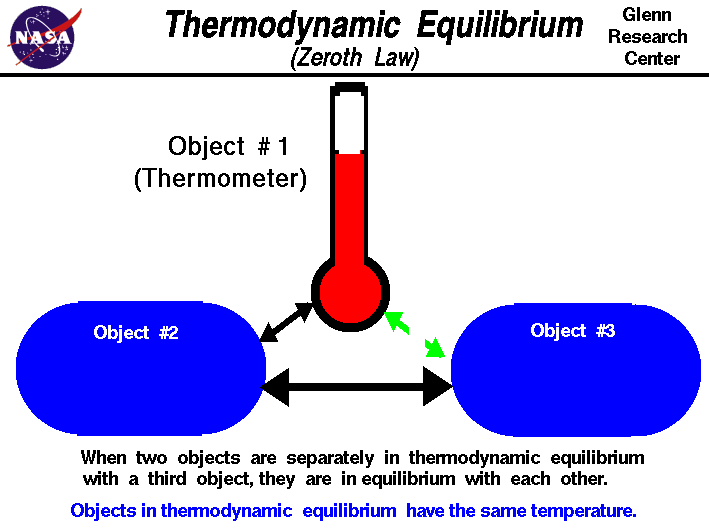
The zeroth law of thermodynamics begins with a simple definition of thermodynamic equilibrium . It is observed that some property of an object, like the pressure in a volume of gas, the length of a metal rod, or the electrical conductivity of a wire, can change when the object is heated or cooled. If two of these objects are brought into physical contact there is initially a change in the property of both objects. But, eventually, the change in property stops and the objects are said to be in thermal, or thermodynamic, equilibrium. Thermodynamic equilibrium leads to the large scale definition of temperature. When two objects are in thermal equilibrium they are said to have the same temperature. During the process of reaching thermal equilibrium, heat, which is a form of energy, is transferred between the objects. The details of the process of reaching thermal equilibrium are described in the first and second laws of thermodynamics.
The zeroth law of thermodynamics is an observation. When two objects are separately in thermodynamic equilibrium with a third object, they are in equilibrium with each other. As an illustration, suppose we have three objects as shown on the slide. Object #1 and object #2 are in physical contact and in thermal equilibrium. Object #2 is also in thermal equilibrium with object #3. There is initially no physical contact between object #1 and object #3. But, if object #1 and object #3 are brought into contact, it is observed that they are in thermal equilibrium. This simple observation allows us to create a thermometer. We can calibrate the change in a thermal property, such as the length of a column of mercury, by putting the thermometer in thermal equilibrium with a known physical system at several reference points. Celsius thermometers have the reference points fixed at the freezing and boiling point of pure water. If we then bring the thermometer into thermal equilibrium with any other system, such as the bottom of your tongue, we can determine the temperature of the other system by noting the change in the thermal property. Objects in thermodynamic equilibrium have the same temperature
Thermodynamics is a branch of physics which deals with the energy and work of a system. Thermodynamics deals only with the large scale response of a system which we can observe and measure in experiments. Small scale gas interactions are described by the kinetic theory of gases. There are three principal laws of thermodynamics which are described on separate slides. Each law leads to the definition of thermodynamic properties which help us to understand and predict the operation of a physical system. We will present some simple examples of these laws and properties for a variety of physical systems, although we are most interested in the thermodynamics of propulsion systems and high speed flows. Fortunately, many of the classical examples of thermodynamics involve gas dynamics.
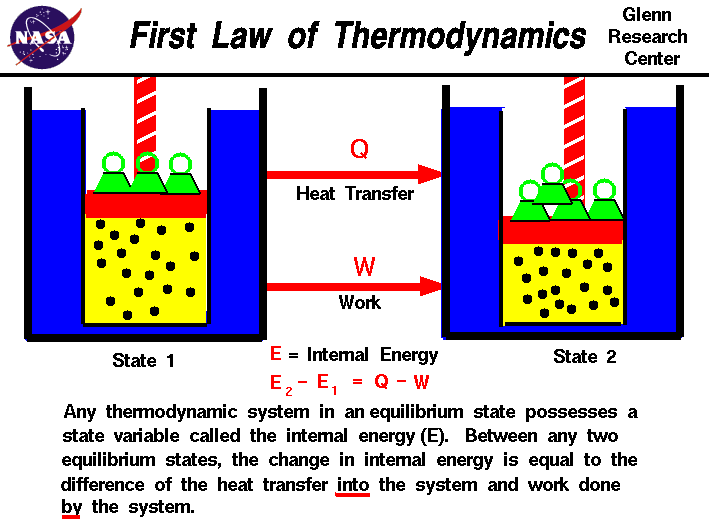
In our observations of the work done on, or by a gas, we have found that the amount of work depends not only on the initial and final states of the gas but also on the process, or path which produces the final state. Similarly the amount of heat transferred into, or from a gas also depends on the initial and final states and the process which produces the final state. Many observations of real gases have shown that the difference of the heat flow into the gas and the work done by the gas depends only on the initial and final states of the gas and does not depend on the process or path which produces the final state. This suggests the existence of an additional variable, called the internal energy of the gas, which depends only on the state of the gas and not on any process. The internal energy is a state variable, just like the temperature or the pressure. The first law of thermodynamics defines the internal energy (E) as equal to the difference of the heat transfer (Q) into a system and the work (W) done by the system.
E2 - E1 = Q - W
We have emphasized the words "into" and "by" in the definition. Heat removed from a system would be assigned a negative sign in the equation. Similarly work done on the system is assigned a negative sign.
The internal energy is just a form of energy like the potential energy of an object at some height above the earth, or the kinetic energy of an object in motion. In the same way that potential energy can be converted to kinetic energy while conserving the total energy of the system, the internal energy of a thermodynamic system can be converted to either kinetic or potential energy. Like potential energy, the internal energy can be stored in the system. Notice, however, that heat and work can not be stored or conserved independently since they depend on the process. The first law of thermodynamics allows for many possible states of a system to exist, but only certain states are found to exist in nature. The second law of thermodynamics helps to explain this observation.
If a system is fully insulated from the outside environment, it is possible to have a change of state in which no heat is transferred into the system. Scientists refer to a process which does not involve heat transfer as an adiabatic process. The implementation of the first law of thermodynamics for gases introduces another useful state variable called the enthalpy which is described on a separate page
Thermodynamics is a branch of physics which deals with the energy and work of a system. Thermodynamics deals only with the large scale response of a system which we can observe and measure in experiments. In aerodynamics, the thermodynamics of a gas obviously plays an important role in the analysis of propulsion systems but also in the understanding of high speed flows. The first law of thermodynamics defines the relationship between the various forms of energy present in a system (kinetic and potential), the work which the system performs and the transfer of heat. The first law states that energy is conserved in all thermodynamic processes.
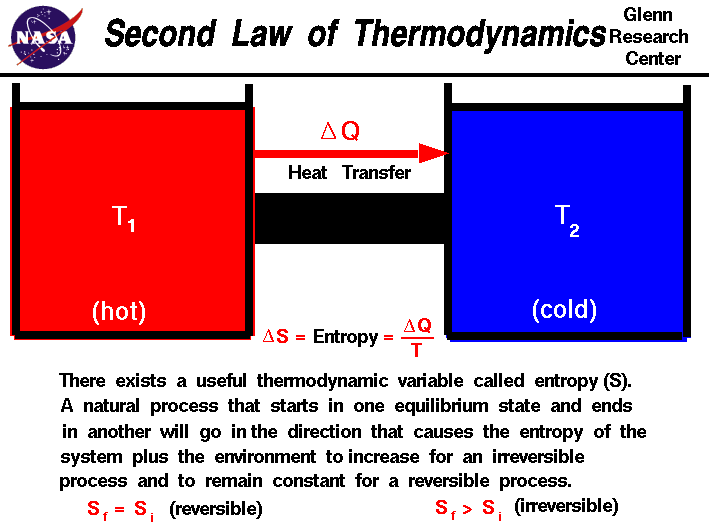
We can imagine thermodynamic processes which conserve energy but which never occur in nature. For example, if we bring a hot object into contact with a cold object, we observe that the hot object cools down and the cold object heats up until an equilibrium is reached. The transfer of heat goes from the hot object to the cold object. We can imagine a system, however, in which the heat is instead transferred from the cold object to the hot object, and such a system does not violate the first law of thermodynamics. The cold object gets colder and the hot object gets hotter, but energy is conserved. Obviously we don't encounter such a system in nature and to explain this and similar observations, thermodynamicists proposed a second law of thermodynamics. Clasius, Kelvin, and Carnot proposed various forms of the second law to describe the particular physics problem that each was studying. The description of the second law stated on this slide was taken from Halliday and Resnick's textbook, "Physics". It begins with the definition of a new state variable called entropy. Entropy has a variety of physical interpretations, including the statistical disorder of the system, but for our purposes, let us consider entropy to be just another property of the system, like enthalpy or temperature.
The second law states that there exists a useful state variable called entropy S. The change in entropy delta S is equal to the heat transfer delta Q divided by the temperature T.
delta S = delta Q / T
For a given physical process, the combined entropy of the system and the environment remains a constant if the process can be reversed. If we denote the initial and final states of the system by "i" and "f":
Sf = Si (reversible process)
An example of a reversible process is ideally forcing a flow through a constricted pipe. Ideal means no boundary layer losses. As the flow moves through the constriction, the pressure, temperature and velocity change, but these variables return to their original values downstream of the constriction. The state of the gas returns to its original conditions and the change of entropy of the system is zero. Engineers call such a process an isentropic process. Isentropic means constant entropy.
The second law states that if the physical process is irreversible, the combined entropy of the system and the environment must increase. The final entropy must be greater than the initial entropy for an irreversible process:
Sf > Si (irreversible process)
An example of an irreversible process is the problem discussed in the second paragraph. A hot object is put in contact with a cold object. Eventually, they both achieve the same equilibrium temperature. If we then separate the objects they remain at the equilibrium temperature and do not naturally return to their original temperatures. The process of bringing them to the same temperature is irreversible.
.
.
